


Summary
Learn magna cum laude requirements (3.7-3.8 GPA), career benefits, and achievement strategies in January 2026. Complete guide to earning this Latin honor.
You’ve kept your GPA high throughout college, but figuring out whether that puts you on track for magna cum laude can get confusing when your school relies on class rank instead of clear GPA cutoffs. Requirements vary widely, with some universities awarding honors to the top slice of each graduating class and others adding rules around credit minimums, theses, or departmental review. This guide explains how colleges determine magna cum laude, what GPA ranges usually qualify, and whether the distinction actually helps when you’re applying to graduate programs or submitting applications through career resources that help present academic achievements clearly to recruiters and admissions teams.
TLDR:
Magna cum laude is typically in the ballpark of 3.7-3.8 GPA or top 10-15% class rank, varying by school.
The honor helps early-career job seekers clear GPA filters used by 71% of employers.
List it in italics after your degree: Bachelor of Arts, magna cum laude.
Graduate programs value it, but research and test scores often matter more.
Certain modern solutions format your honors correctly and tailor each resume to match job-specific keywords.
What Is Magna Cum Laude?
Magna cum laude is a Latin honor translating to "with great praise" that recognizes students who graduated in the top tier of their class academically.

Within the three-level Latin honors system, magna cum laude ranks between cum laude (with praise) and summa cum laude (with highest praise). Most colleges award it to students in the top 10-15% of their graduating class, typically requiring a GPA around 3.7 to 3.8, though exact thresholds vary by institution.
The honor appears on your transcript, diploma, and commencement programs. Some schools also provide special cords or stoles during graduation ceremonies to recognize students who earned this distinction.
GPA Requirements for Magna Cum Laude
GPA cutoffs for magna cum laude typically range from 3.7 to 3.8, though schools vary widely in how they calculate honors. Some use fixed thresholds, while others rely on class rank percentiles.
Check your school's registrar office or academic handbook for exact requirements. If your institution uses percentile rankings, your standing relative to classmates matters more than a specific number.
How Universities Determine Latin Honors
Universities calculate Latin honors through two primary methods: fixed GPA cutoffs or percentile-based ranking. Schools with fixed thresholds set specific numbers (like 3.7 for magna cum laude) that remain consistent year to year. Percentile systems award honors to the top percentage of each graduating class, so the actual GPA requirement fluctuates based on cohort performance.
Harvard College became the first U.S. institution to award final honors in 1869, initially offering only cum laude and summa cum laude from 1872 to 1879. Magna cum laude joined in 1880, creating today's three-tier structure.
Many universities add requirements beyond GPA:
Minimum credit hours earned at the institution, often requiring substantial on-campus residency instead of transfer credit
Completion of an honors thesis, capstone project, or department-specific research requirement
Faculty committee review or formal recommendation letters
Clean academic integrity record with no violations
Specialized coursework or departmental criteria
Check your school's specific policies early in your college career.
Does Graduating with Magna Cum Laude Matter for Your Career?
Magna cum laude carries the most weight early in your career when work experience is limited, especially when using job search platforms for recent college graduates. The honor signals strong analytical ability, discipline, and consistent performance under pressure, complementing the key resume skills that help you stand out in competitive fields like consulting, finance, law, and tech.
According to NACE's Job Outlook Survey, 71% of employers screen candidates by GPA for entry-level roles, making it important to learn the best way to get a job interview once you meet these criteria. Latin honors can help you clear initial filters in large applicant pools where many candidates hold similar degrees.
The distinction loses relevance as you build professional experience. Recruiters tend to place emphasis on work achievements, skills, and project outcomes over academic metrics like GPA or honors, so focus on how to land your first job fast while the honor still carries weight. Still, the credential never disappears. It can reinforce credibility for career changers or professionals re-entering the job market after gaps.
Latin Honors and Graduate School Admissions
Latin honors like magna cum laude signal academic readiness to graduate programs, helping distinguish you when GPAs and test scores look similar. Research-focused PhD programs value these distinctions as proof of consistent intellectual performance over four years.

However, admissions committees weigh multiple factors. A 3.6 GPA with research publications, strong recommendations, and relevant experience can outperform a 3.9 with honors but weak extracurriculars, similar to writing a cover letter with little experience where quality matters more than quantity. Medical schools focus on clinical exposure and MCAT scores. Law schools focus on LSAT results and writing samples.
Latin honors strengthen applications but don't guarantee admission. They work best alongside compelling personal statements, relevant experience, and solid test scores.
How to List Magna Cum Laude on Your Resume and Applications
Place magna cum laude in your education section directly after your degree name when you tailor your resume to job descriptions. Write it in lowercase italics: Bachelor of Arts in Economics, magna cum laude. This formatting is a common stylistic choice for readability and does not interfere with applicant tracking systems, regardless of whether you choose one column or two columns for your layout.
For recent graduates, include your GPA if it's 3.5 or higher alongside the honor: "Bachelor of Science in Biology, magna cum laude, GPA: 3.85," or use ChatGPT resume prompts to help format this section. Once you have three or more years of work experience, drop the GPA and keep just the Latin honor.
Remove Latin honors from your resume after about five to seven years in your career. At that stage, recruiters care more about your accomplishments and leadership than college performance.
On job applications that ask for honors separately, list it in the designated field. If there's no specific field, include it in the education section or additional information area.
Achieving Magna Cum Laude: Strategies for Academic Success
Earning magna cum laude requires planning early and staying consistent. Choose courses strategically, balancing challenging classes with your strengths. Meet professors during office hours to deepen understanding and build relationships that support strong recommendations later.
Use campus tutoring centers, writing labs, and study groups when material gets difficult. Track your GPA each semester so you know exactly where you stand and can adjust before senior year.
Balance matters too. Burnout derails grades faster than a single bad exam. Schedule downtime, sleep enough, and stay involved in activities you care about outside class. Consistency across all four years matters more than one perfect semester.
Optimizing Your Job Applications with Sprout
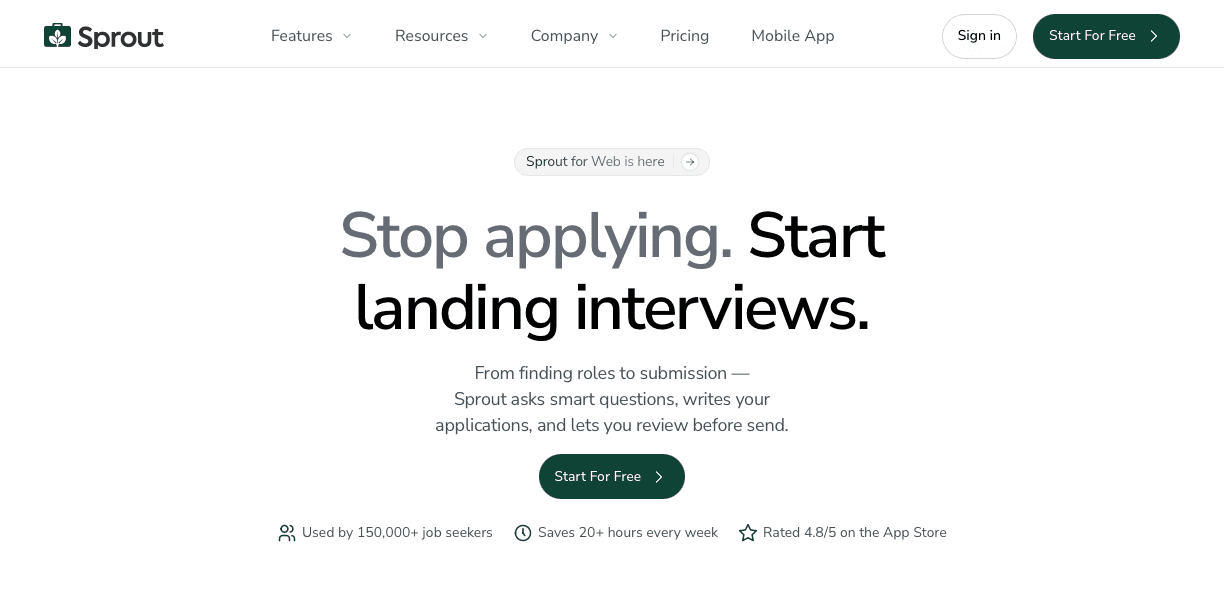
Earning magna cum laude gives you an edge, but only if employers see it formatted correctly. Many graduates list honors once, then send the same resume everywhere.
Sprout automatically include your academic honors into each tailored resume and cover letter, formatted consistently (magna cum laude) so it remains readable and ATS-compatible across application systems. We position it strategically based on each role, whether that's particularly for competitive entry-level programs or integrated naturally where experience matters more.
Our keyword alignment pulls terms directly from each job description and weaves them with your academic achievements, helping you find jobs based on your resume that match your qualifications. If a firm places emphasis on "analytical rigor," Sprout connects those phrases to your Latin honor within achievement-based bullets, showing employers exactly why your distinction matters for their specific opening.
FAQs
Does magna cum laude matter for medical school or law school admissions?
Magna cum laude strengthens your application by showing consistent academic performance, but it won't compensate for weak MCAT/LSAT scores or limited relevant experience. Graduate programs look at the full picture. Test scores, research, clinical exposure, recommendations, and personal statements matter just as much or more than Latin honors alone.
How should you format magna cum laude on your resume?
Place it in lowercase italics directly after your degree name in the education section: "Bachelor of Science in Computer Science, magna cum laude." This formatting follows academic convention and parses correctly through applicant tracking systems that employers use to screen applications.
When should you remove Latin honors from your resume?
Remove magna cum laude after about five to seven years of professional experience. At that point, recruiters care more about your work accomplishments, leadership roles, and measurable results than college performance, so the honor takes up valuable resume space without adding much value.
Final Thoughts on Making Magna Cum Laude Work for You
Earning magna cum laude reflects consistent effort and academic discipline, but its real value comes from how clearly it connects to the role you want next. Sprout helps translate that distinction into applications that speak the language employers screen for, formatting your Latin honor correctly and aligning it with the skills and signals each job description calls out. When magna cum laude is woven into tailored resumes and cover letters through a tool like Sprout, it moves from a static credential to a clear signal of fit, giving your applications more pull in competitive early-career hiring.