

Summary
Learn how to find jobs based on your resume using AI tools in January 2026. Get 2x more interviews by matching your skills to roles where you already fit.
Most job seekers do this backwards. They find a listing, then spend an hour rewriting their resume to maybe fit. Instead, you should find jobs based on your resume first, so you are only applying where your background actually aligns. Modern tools can read your experience and surface roles where you are already qualified, which means less guessing, fewer rejections, and more interviews with companies that genuinely need what you bring to the table.
TLDR:
Modern matching tools scan your resume and job posts together to showcase roles where your skills clearly align with the listed requirements.
Resume data shows tailored applications can generate roughly twice as many interviews as generic, one‑size‑fits‑all submissions.
Most large employers now use ATS software, and many applications are filtered automatically based on exact keyword matches before a recruiter ever reads them.
Sprout’s internal tracking reports that users secured 2,738 interviews in October using its ATS‑friendly, job‑specific resume tailoring.
What Is Resume-Based Job Matching and Why Does It Matter
Most people hunt backward: they find a listing first, then cut and paste their CV to fit. Resume‑based matching flips that process, so your existing experience guides where you apply. These tools scan your hard skills and work history to surface roles where you fit naturally, instead of forcing a square peg into a round hole.
Precision matters. Resume statistics show recruiters scan documents in seconds, so clear alignment wins. If you are not a near‑match on paper, you are likely rejected quickly. Job‑search trend data also shows that high‑quality matches over random volume improve success rates, so letting your actual experience lead the search pays off.
How ATS Systems Filter Resumes and Why Keyword Matching Matters
Before a hiring manager sees your name, an Applicant Tracking System (ATS) often reads your resume first. Many large employers rely on ATS tools to sift through high application volumes, and these systems look for specific terms taken directly from the job description.
If a posting asks for “Python” and you only write “coding,” you may not register as qualified in the system. Structure matters too: complex columns, graphics, or unusual layouts can break parsing, so clear headings and simple text help you get past the automated screen and into a real review.
Traditional Methods for Finding Jobs Based on Your Resume
Before smarter matching arrived, finding work meant relying on hope and basic keyword searches; it works, but it is slow and easy to misfire.
The "Upload to Match" Feature
Legacy job boards often scan for keyword frequency, not context, so if you managed a budget five years ago, these parsers might suggest Senior Accountant roles because they see “finance” and miss your actual career direction.
Manual Boolean Searches
Typing skills with operators like AND/OR is precise but painful; you have to guess the exact title a recruiter picked, so searching for “Content Writer” means you might miss a posting labeled “Brand Storyteller.”
How AI Job Matching Tools Analyze Your Resume
Older scanners required exact keyword matches to trigger results, but newer systems read for context and relationships among skills. They strip your PDF down to structured data, recognizing that “client relations” overlaps with “customer success” even if you did not write those exact words.
The software also understands hierarchy, so that the management role you held last year ranks higher than the internship you did in college. Instead of a random job dump, the system compares your data against verified listings and looks for a statistical fit, showcasing roles where you meet the core requirements, so you stop wasting time on applications that go nowhere.
The Real Numbers Behind Tailored vs. Generic Applications
Sending the same PDF to fifty companies feels productive, but it is usually a waste of bandwidth because generic applications fail to show you are the specific solution to a company’s problem. Tailored resume statistics indicate that customized resumes generate approximately 6 interview opportunities per 100 applications, compared to fewer than 3 for generic submissions, roughly doubling
Recruiters and automated screeners focus on candidates who clearly match their criteria, which is why learning how to get a job interview starts with alignment, not volume.
criteria. Customizing your resume connects the dots so they do not have to guess; if you force them to hunt for your qualifications, they will not.
Comparing Search Strategies
You do not have to sacrifice volume for quality if you scale the tailoring process correctly, but doing it manually makes volume the enemy. Focus on how to find jobs based on resume strengths, and the response rates will follow.
Metric | Spray-and-Pray Approach | Strategic Quality Approach |
|---|---|---|
Strategy | Apply to everything remotely relevant | Apply only where skills align strongly |
Resume Style | One generic PDF for all roles | Unique version for every single job |
ATS Success | Low (keyword mismatch) | High (optimized for specific criteria) |
Recruiter Perception | Looks lazy or desperate | Looks intentional and professional |
Response Rates Across Different Job Boards and Application Methods
Big social networks feel productive, but they are often congested spaces where applications get buried under thousands of easy‑apply clicks. Research shows Google Jobs response rates sit around 9.3%, nearly triple the 3.3% success rate on LinkedIn.
Aggregators like Google and the verified listings inside Sprout perform better in part because they direct you straight to the source career page. You bypass the third‑party holding pen and get your tailored resume in front of the people who actually make hiring decisions.
Tracking Your Applications and Measuring Success
Applying to thirty jobs a week and hearing nothing is a tracking problem as much as a resume problem. You need to know where your resume lands and what comes back; otherwise, you are flying blind.
Treat your search like a sales funnel: watch which boards you get interviews from, which are dead ends, and how different versions perform. Sprout consolidates this data, showing exactly which applications stick so you can focus on what works and drop what does not.
Find Jobs Based on Your Resume With Sprout
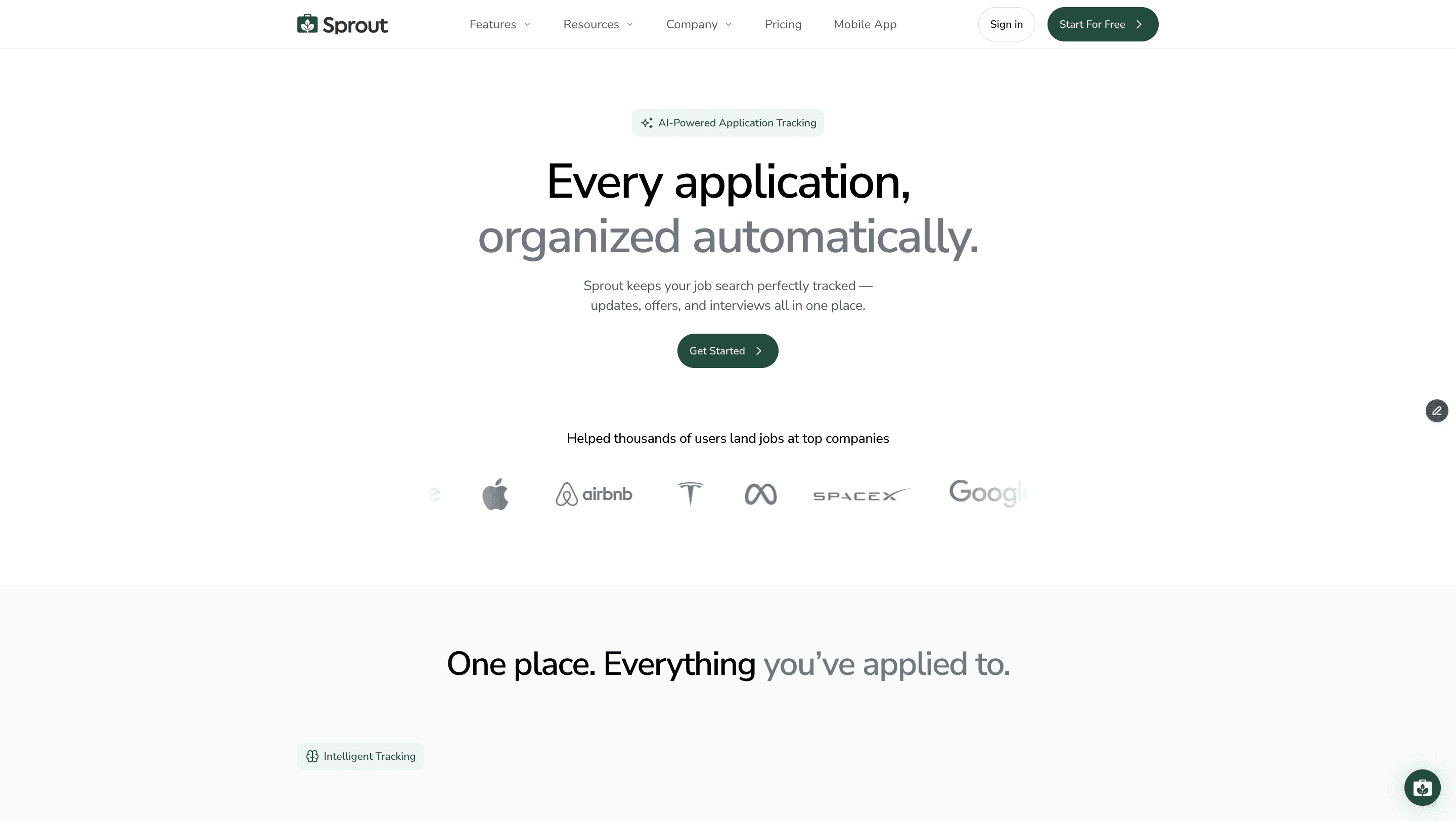
Sprout stops the keyword guessing game by aggregating listings directly from verified career pages and filtering out scams, so you only see roles matching your actual experience. Once you find a fit, Sprout analyzes the job description to rewrite your resume bullets and reorder skills so the ATS sees your most relevant qualifications first.
You review the match, confirm the changes, and Sprout handles the form‑filling, which helped users land 2,738 interviews in October at companies ranging from large brands to high‑growth teams, according to internal tracking
Final Thoughts on AI Job Search Tools and Resume Matching
Sending the same PDF to fifty companies feels productive, but rarely works in an ATS‑driven market. The best job search tools analyze your resume in context, match you to roles where you meet core requirements, and customize each application so recruiters see an immediate fit. When you track what sticks, refine your targeting, and let your actual skills drive the search, you trade random volume for predictable interviews.
FAQs
How does AI job matching differ from traditional job board searches?
Traditional job boards rely on exact keyword matches and often miss context if you wrote "budget management," but the posting says "financial planning," you won't show up. AI job matching reads for meaning and context, understanding that your "client relations" experience translates to "customer success" roles even without identical phrasing.
Can I trust AI to customize my resume without making it look fake?
You shouldn't blindly trust any AI; always review the output before submitting. Sprout tailors your resume by pulling actual keywords from each job description and rewriting your real experience to match, which passes both ATS scans and human review, but you still need to proofread to catch any awkward phrasing or errors.
Why do my applications on LinkedIn get fewer responses than other job boards?
LinkedIn's easy-apply feature creates massive competition; your application gets buried under thousands of one-click submissions, resulting in a 3.3% response rate. Direct applications through company career pages (like those aggregated in Google Jobs or Sprout) hit 9.3% because you bypass the crowd and land directly in front of hiring teams.
How many jobs should I apply to each week for the best results?
Quality beats quantity every time. Applying to 10 highly matched roles with tailored resumes yields roughly 6 interviews per 100 applications, while spraying 50 generic resumes to random postings yields an average of 3 interviews per 100 applications. Focus on roles where your skills actually align instead of chasing volume just to feel productive.
What makes a resume truly ATS-friendly beyond just adding
ATS systems need a clean structure to parse your information correctly: use standard section headers like "Work Experience" and "Education," avoid tables or multi‑column layouts that scramble data, and stick to simple fonts that render consistently. ATS-friendly resume builders can help you create documents that pass these technical requirements automatically.