
Summary
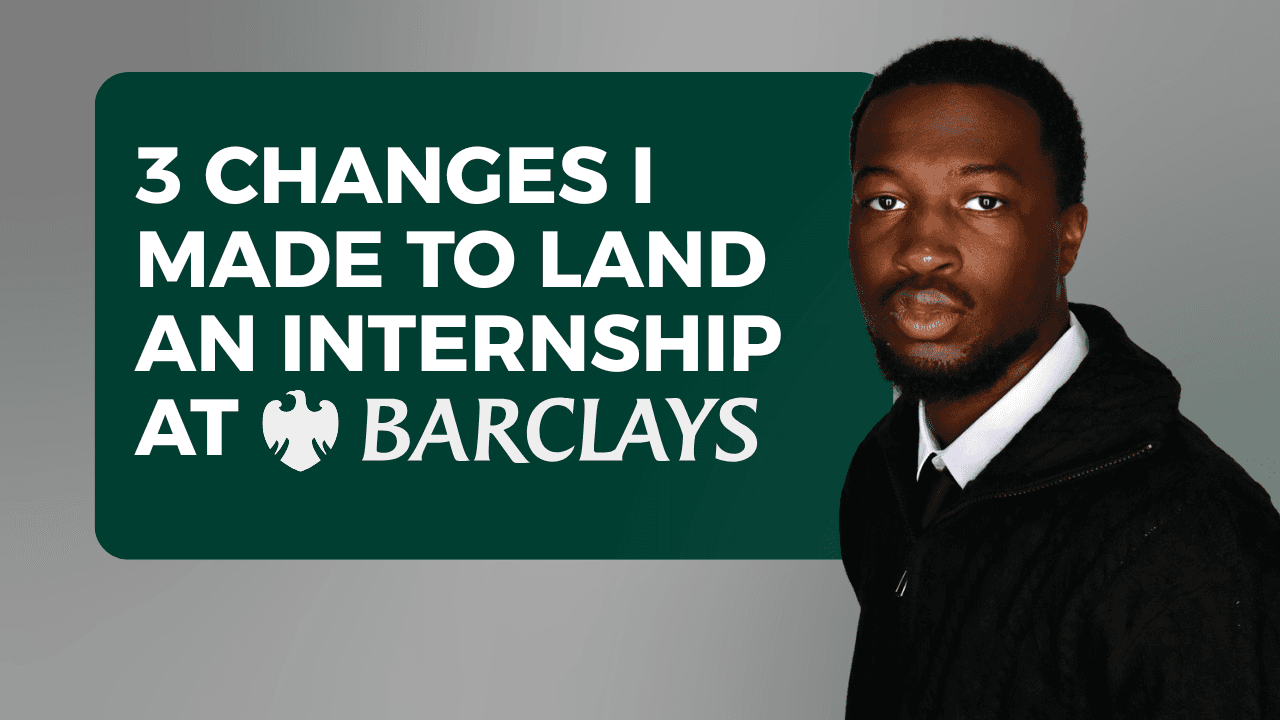
Learn how one college junior went from constant rejections to landing a Barclays internship by widening his role strategy, strengthening his resume, and applying faster without sacrificing quality.
Want to hear the full story? Watch the full interview here.
TL;DR:
After months of sending applications and hearing nothing back, Michigan State junior Augustine Blay landed a finance internship at Barclays by making three key changes: widening the roles he applied to, rebuilding his resume to clearly match finance and consulting expectations, and dramatically speeding up his application process without sacrificing quality. By combining a smarter targeting strategy with faster, tailored applications, he went from constant silence to interview traction and ultimately an offer.
If you’re in college right now, recruiting can feel brutal.
You do what you’re “supposed” to do. Apply on LinkedIn. Apply on company sites. Maybe even network. And still, nothing happens. No interviews. No replies. Just the feeling that everyone around you is moving forward while you’re stuck refreshing your inbox.
Augustine Blay was in that exact spot. He’s a junior at Michigan State University studying economics with a minor in resource management. He started college aiming for marketing, then pivoted into more analytical paths like finance and consulting. That change is common, but it comes with a problem: your resume and your strategy usually lag behind your new direction.
He kept applying anyway. And at first, it wasn’t working.
By the end of his recruiting cycle, Augustine landed a finance internship at Barclays as an Operations Analyst Intern, located in Whippany, New Jersey. What changed wasn’t because of luck. It was a few specific shifts in how he approached the process.
This case study breaks down the three changes he made and how Sprout helped him move faster without sacrificing quality.
The starting point: “Beggars can’t be choosers”
Augustine said something that a lot of juniors think but don’t always admit.
Once you hit junior year, the clock feels loud. It becomes less about the “perfect” role and more about getting into the right general lane. For him, that lane was finance or consulting.
He wasn’t initially targeting finance ops or Barclays specifically. His goal was simpler: get in the door, then use that internship as a launch pad.
Three big motivators drove him:
Peer pressure
Being around high-performing students in a consulting org made the gap feel real fast.Ego, in the healthy sense
“If they can do it, I can do it.” He wanted to prove to himself he could compete.Career reality
He didn’t want to graduate into a multi-year gap with nothing lined up.
That mix created urgency. And urgency is useful, but only if you pair it with a smarter system.
What recruiting looked like before
Before using Sprout, Augustine described the process as fragmented and exhausting.
He’d send 20 applications and hear back from one, sometimes none. The hardest part wasn’t even rejection. It was silence, especially after long applications that took real time to complete.
He was also juggling school and student org responsibilities. So the biggest constraint wasn’t motivation. It was time.
Change 1: Expand the target, not just the volume
At first, Augustine was applying in mass only to roles he personally liked.
The problem was that “ultra specific” roles don’t give you enough surface area. If you only apply to a tiny slice of roles, you end up networking hard with five companies, waiting, and losing weeks.
His first major shift was widening what he considered acceptable.
Instead of only targeting one narrow title, he expanded into adjacent roles like:
finance roles beyond wealth management
data analytics roles
business analytics roles that blended finance and consulting style work
That created more opportunities, but it also created a new problem: more roles means more tailoring, and tailoring manually takes forever.
That’s where he needed a system, not just more effort.
Change 2: Rebuild the resume so it actually matched the story
Augustine said something that’s painfully real:
He knew he could do the job, but he didn’t feel his resume made that obvious.
Early on, he was sending a generic resume everywhere because he didn’t even realize tailoring was an “unwritten rule.” Later, when he started aiming for more competitive paths like consulting, he noticed a gap in language, keywords, and signals.
So he paused recruiting for about two to three weeks and did a real rebuild.
What he changed:
Worked with his career counseling office to align his resume with business expectations
Added baseline skill signals that show up repeatedly in job descriptions
Excel, SQL, Tableau, PowerPointStarted thinking in “proof” and interview stories, not just bullet points
For example, he highlighted client-facing project experience through his consulting org
One of his favorite projects was working with a client building a student counseling tool that helps students explore careers and paths. It mattered because it gave him real client-facing examples to talk about in interviews.
He also noticed something funny: he actually applied to Barclays with an older version of his resume.
And it still worked.
Not because the resume was perfect, but because recruiting is a numbers game and momentum matters. His bigger point was that the resume rebuild increased his response rate, even before it led to offers.
Change 3: Create speed without losing quality
This was the turning point.
Augustine described the classic trap:
Option A: overthink every application, manually tweak everything, move slow
Option B: blast the same generic resume everywhere, move fast, get filtered
His “pre-Sprout” workaround was honestly smart: he batched his recruiting into two-week sprints.
Two weeks applying to consulting with a tailored consulting version, then two weeks applying to finance with a tailored finance version.
It reduced constant switching, but it still meant spending around 15 minutes per application just checking details and customizing.
Once he started using Sprout, that changed.
He said his time per application dropped from about 15 minutes to about 2 minutes.
That extra time went back into things that actually matter:
school
staying involved on campus
networking when it’s strategically useful
simply not burning out
And importantly, he didn’t feel like he was choosing between speed and quality anymore.
What he did once Barclays responded
Augustine’s Barclays application started as a cold application.
No referral. No inside contact.
But the moment he got the assessment and saw a signal that he was being considered, he moved fast:
went on LinkedIn
looked up people in the same role and adjacent leadership roles
messaged them asking about day-to-day work and how to bring value on day one
made sure his name existed “in the system” somehow, even if just through outreach
His mindset: if he could walk into interviews and say “I spoke to X and Y,” it signals preparation and seriousness.
His best advice for students still waiting to hear back
He gave two pieces of advice that are simple but real.
Don’t give up too early
The job market is tough, but that’s not a reason to stop applying.Don’t apply blindly
Research matters, and the attempt to find info usually gets you further than people expect.
His research strategy was practical:
Talk to seniors in student orgs related to your career interests
They’ll give you real step-by-step advice, not generic tips.Reach out to older people in your network or alumni doing the job you want
Coffee chats. Phone calls. Direct, usable insight.
And if you’re getting rejected nonstop?
His answer was mindset-first: don’t take it personally. A lot of systems are automated. A lot of rejections aren’t even fully human decisions. Keep going.
His line was simple: keep punching the wall, it breaks.
The bottom line
Augustine didn’t win recruiting by magically “trying harder.”
He won by shifting the system:
broadened what roles he was willing to consider
rebuilt his resume to match the direction he wanted
created speed without losing quality
used outreach at the right moment, when signals showed he was being considered
And after months of rejections and silence, those changes helped him land a Barclays internship.
If you’re in the same spot he was in, the goal isn’t to be perfect. It’s to stay in the game long enough, with a system that doesn’t burn you out.