


Summary
Learn how to bulk apply to jobs in January 2026 with AI tools. Apply to 100+ positions fast while passing ATS screens. Get 2-10% interview rates per 100 apps.
Long gone are the nights spent polishing a single application while hundreds of similar candidates race ahead. In 2026, winning the search means learning how to bulk apply to jobs fast without tripping ATS filters that quietly screen out a large portion of applications. That requires a smarter approach using a company-neutral application tool you can read about here, one that pulls keywords from each posting, rewrites your resume bullets to match real requirements, and fills forms for you so every submission still reads job-specific. The goal is simple: apply broadly, move quickly, and stay credible enough to land interviews instead of disappearing into the void.
TLDR:
Bulk applying works when you pair volume with ATS-optimized tailoring; expect 2-10% interview rates per 100 applications.
AI tools can reduce application time from 30–60 minutes to just a few minutes per role by automating keyword alignment, document generation, and form filling.
Customize fully when you hit 80%+ qualifications; use AI for 60-75% matches to maintain quality at scale.
Certain modern tools auto-generate tailored, ATS-friendly resumes for each job and track all applications in one dashboard.
Bulk applying without tracking leads to missed follow-ups and duplicate submissions; centralized dashboards protect your response rate and recruiter credibility.
What Is Bulk Job Application and Why It Matters in 2026
Bulk job application means submitting to multiple roles quickly, often with automation or templates. Instead of spending hours on each application, you can apply to dozens or hundreds of positions in less time.
Many job seekers report sending anywhere from several dozen to well over 100 applications before landing an offer, depending on the role and market conditions. Competition is high, response rates are low, and most applications vanish into ATS systems. The 2026 job market rewards volume paired with smart targeting. Spamming generic resumes doesn't work. You need to apply broadly while tailoring each submission enough to pass automated screens.
The Numbers Behind Bulk Applying: Success Rates and Statistics
When you apply in bulk, average interview rates range from 2 to 10% depending on industry and experience. For every 100 applications, expect 2 to 10 responses. Many candidates now need dozens of applications to land a single offer, with senior and competitive roles often requiring considerably more. Tracking your applications helps you stay organized through this process. If you want three interviews in a month, submit at least 30 to 50 quality applications. Bulk applying works by building a funnel where volume compensates for low conversion rates.
How ATS Systems Screen Your Applications at Scale
ATS software parses your resume, extracts work history and skills, then ranks candidates by keyword matches and formatting. 97.8% of Fortune 500 companies use an ATS, so bulk applications need clean formatting from the start.

Systems flag non-standard headers, tables, or images, scrambling data or rejecting files outright. Using ATS-friendly resume builders helps avoid these issues. Match exact job titles, required skills, and experience from each posting. Format your resume correctly once, then apply at scale knowing it will parse cleanly every time.
AI Job Application Tools: How They Work
AI job application tools scan job descriptions to extract required skills, experience, and keywords, then match those requirements against your profile and rewrite resume bullets and cover letters to align with each posting.
Most tools use LLMs to generate text that mirrors the job language. Chrome extensions inject your information into web forms, while standalone apps assist with application workflows by guiding submissions or automating form completion where permitted. Learn more about auto apply features and how they work. The best tools check ATS compatibility before sending, swapping complex formatting for plain text and standard headers.
Speed vs. Personalization: Finding the Right Balance
Raw speed kills your response rate. Tailored cover letters pull 16.4% callbacks versus 10.7% for generic ones. But customizing every application manually caps you at 5 to 10 per day.
The solution is selective depth. Reserve full personalization for roles you genuinely want at companies where you fit closely. For broader applications where you meet 60 to 70% of qualifications, use an AI tool to handle keyword alignment and basic tailoring so you can apply to 20 or 30 positions daily without sacrificing ATS compatibility.
Creating an ATS-Optimized Base Resume
Start with a master resume in plain text or Google Doc format that includes every relevant job, skill, certification, and achievement from your career. When you tailor applications, you'll pull from this inventory instead of rewriting from scratch.
Use standard section headers like "Work Experience," "Education," "Skills," and "Certifications." ATS systems expect these labels, so skip creative titles. List skills with exact phrases from target job descriptions. Keep fonts simple (Arial, Calibri, Times New Roman at 10–12 points) and avoid tables, text boxes, headers, footers, and graphics. Single-column layouts parse cleanly.
Write achievement-based bullets under each role: "Increased sales 23% in Q3" beats "Responsible for sales." Front-load bullets with action verbs and outcomes.
Time Investment: How Long Should Each Application Take
Manual applications take 30 to 60 minutes when you tailor resumes, write cover letters, and fill forms. Five applications can consume an entire evening.
AI tools can reduce application time to just a few minutes per role. Sprout generates tailored resumes and cover letters in seconds, then auto-fills forms so you swipe and move on. Fifty applications drops from weeks of work to under a few focused hours.
Spend saved time on interview prep and networking where personal touch matters.
Common Mistakes When Bulk Applying to Jobs
Sending applications to roles you're not qualified for burns through credits and tanks your response rate. If a job asks for five years of experience and you have six months, move on.
Using the same resume everywhere reduces keyword relevance for different roles, lowering how well your application ranks in ATS screenings. A marketing role needs different keywords than a finance position, even at the same level. AI can swap keywords per job so each submission matches what the system expects.
Forgetting where you applied leads to duplicate submissions, which some ATS systems flag or deprioritize. A tracking dashboard logs every application with dates and status to prevent this.
Tracking and Managing High-Volume Applications
When you apply to dozens of jobs, track where you applied, which resume version you sent, and when to follow up. Auto-logging tools capture company name, role, date, and status in one dashboard.
Set calendar reminders to follow up one week after applying. Check your tracker twice weekly for recruiter emails or interview requests. Tag applications as "waiting," "interviewed," or "rejected" to focus your energy.
Sprout's dashboard automatically records every application and syncs across devices in real time. You'll see exactly which resume and cover letter went to each employer, preventing duplicate submissions and missed follow-ups. When a recruiter reaches out, pull up your submitted materials instantly.
When to Customize vs. When to Apply Quickly
Fully customize when you hit 80% or more of required qualifications and genuinely want the role. Add company research, name-drop projects or values, and rewrite bullets to mirror their exact language.
Apply quickly with AI-generated tailoring when you meet 60 to 75% of requirements or the company is outside your top-tier list. Let the tool handle keyword swaps and ATS formatting while you focus volume on roles where timing or broad exposure matters.
Skip if you're under 50% qualified or the role conflicts with your career direction. Wasting applications here lowers your overall response rate and dilutes your effort.
How Sprout Solves the Bulk Apply Dilemma
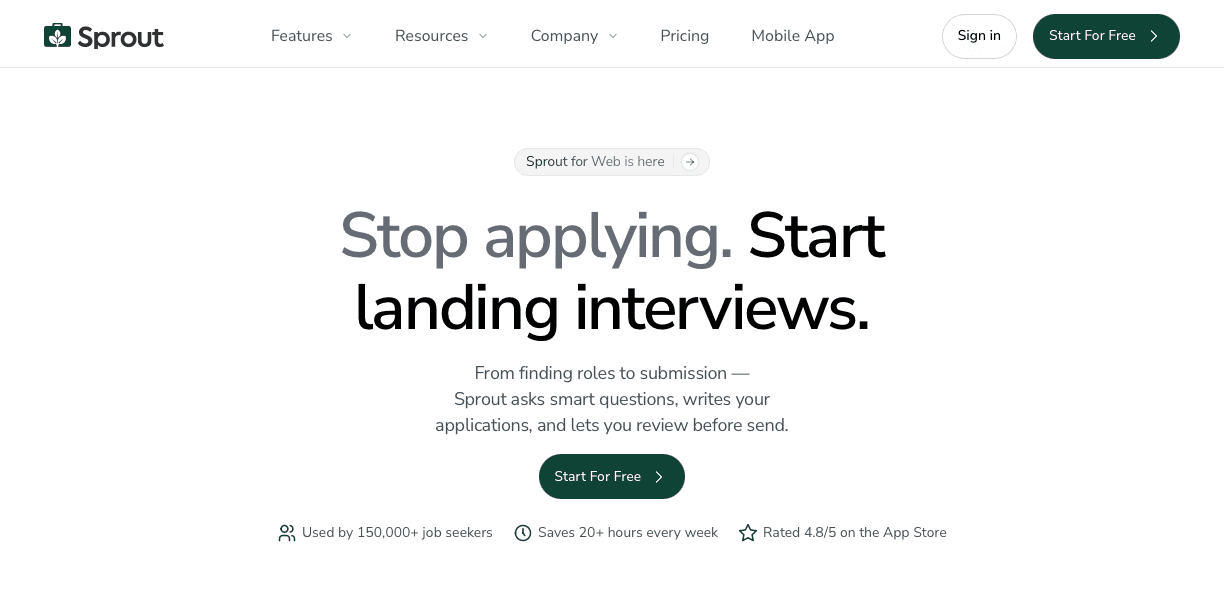
Sprout is built for job seekers who need to move fast without sacrificing credibility. Instead of sending the same generic resume everywhere, Sprout lets you swipe on roles you actually want, then automatically generates a tailored resume and cover letter for each posting. It pulls required skills, keywords, and action verbs directly from the job description and rewrites your bullets to match what ATS systems and recruiters are scanning for, all while keeping formatting clean and readable.
What makes this scalable is consistency. Every document follows ATS-friendly structure with standard section headers and keyword-aligned bullets, so applications parse correctly across systems without manual rework. You can apply broadly while still submitting materials that read as role-specific, not mass-produced.
Sprout also solves the organization problem that breaks most high-volume searches. Every application is logged automatically in a single dashboard, showing which resume and cover letter were sent, when you applied, and where each role sits in the process. That prevents duplicate submissions, missed follow-ups, and the common “wait, what did I send them?” moment when a recruiter replies. The result is a controlled, high-volume workflow where speed supports interview traction instead of working against it.
FAQs
What makes a resume ATS-friendly when bulk applying?
ATS-friendly resumes use standard section headers like "Work Experience" and "Skills," avoid tables or text boxes that scramble parsing, and include exact keywords from the job description in achievement-based bullets. Single-column layouts with simple fonts (Arial, Calibri) at 10-12 points parse cleanly through the 97.8% of Fortune 500 systems that screen applications automatically.
How long does each application take with AI tools versus manual submission?
Manual applications take 30 to 60 minutes per job when you tailor resumes, write cover letters, and fill forms. Five applications can consume an entire evening. AI tools like Sprout cut this to just a few minutes per job by generating tailored documents in seconds and auto-filling forms, so 50 applications can drop from weeks of work to just a few focused hours.
Can applying to too many jobs hurt my response rate?
Yes. Sending applications to roles where you're clearly unqualified (under 50% match) or using identical resumes for different positions tanks your response rate and wastes application credits. Track where you apply to prevent duplicate submissions, which some ATS systems flag or deprioritize, and focus volume on roles where you meet at least 60% of requirements.
Final Thoughts on High-Volume Job Searching
High-volume job searching only works when speed and relevance move together. Manually sending 50 applications drains time and momentum, while modern AI tools handle the repetitive work like resume tailoring, form filling, and application tracking so you can stay focused on interviews. The goal is to bulk apply to jobs where you meet at least 60% of the requirements, slow down for roles you truly want, and keep every submission organized in one place. Sprout supports this approach by generating role-matched resumes and automatically logging each application, helping turn volume into real interview traction.