

Summary
Not getting interviews? Learn what's blocking your applications, from ATS filters to timing issues, and how to fix them in April 2026.
You've been sending out applications for weeks, maybe months, and the silence is loud enough to make you wonder: "why am I not getting interviews?" If you're not getting job interviews even when you check all the boxes, the problem usually starts before a human ever sees your name. Most of it comes down to a handful of fixable issues that have nothing to do with whether you can do the job.
TLDR:
Your resume gets filtered by ATS software before humans see it. Wrong formatting drops you instantly.
Tailored applications can get 10-15% response rates versus 2-3% for generic ones.
Applying within 48 hours of posting makes you 4x more likely to land an interview.
Ghost jobs waste your time, so skip listings live 60+ days with vague descriptions.
AI-powered application tools can create ATS-optimized, role-specific resumes for every job, helping users generate more interview opportunities each month.
Your Resume Isn't Optimized for Applicant Tracking Systems
Before a recruiter ever sees your resume, software has already helped determine how your application is ranked. Applicant Tracking Systems scan, parse, and rank every submission, and only about 2-3% of applicants make it to the interview stage. Nearly 99% of Fortune 500 companies use these systems to filter candidates automatically. If your formatting is off, your resume might be read as a jumbled mess of symbols and scrambled text. ATS check tools can scan your resume before you submit it to catch these issues.
The usual culprits are things most people never think twice about: multi-column layouts, tables, text boxes, and fancy fonts. Some ATS systems may struggle to parse these formats correctly. Standard section headers like "Work Experience" and "Education" also matter more than you'd expect since creative alternatives like "Where I've Been" get ignored entirely.
Keywords are the other half of the equation. ATS filters score resumes against the job description, so if you're not mirroring the exact language the employer used, your match score drops fast.
You're Applying to Roles That Don't Match Your Experience Level
Applying to the wrong tier of roles is one of the fastest ways to disappear into a black hole of silence. It cuts both ways.
If you're underqualified, ATS systems often filter you out automatically before a human ever gets involved. But being overqualified carries its own risk. Recruiters worry you'll leave the moment something better comes along, so they skip you too.
Entry-level roles have gotten harder to crack as well. Available postings have dropped 29 percentage points since January 2024, meaning more candidates are fighting over fewer spots. Targeting the right level matters more now than it ever has.
A quick gut check: if a job requires 5+ years of experience and you have two, move on. If every requirement on the list feels like a stretch, that's a signal. Aim for roles where you meet roughly 70-80% of listed qualifications.
Your Application Materials Aren't Tailored to Each Job
Sending the same resume to 50 companies feels productive. It rarely is.
Generic applications sit at that 2-3% response rate we mentioned. Tailored ones? Closer to 10-15%. That gap exists because recruiters can tell within seconds whether you actually read the job description or just hit send.
True tailoring goes beyond swapping company names. It means rewriting bullet points to reflect the specific skills and verbs in that posting, adjusting your summary to speak to that team's actual needs, and leading with the experience most relevant to that role.
A few specific things to adjust for every application:
Reorder your experience bullets so the most relevant ones appear first
Match the exact job title language used in the posting
Tweak your summary or objective to reflect the company's priorities
Remove experience that adds noise without adding relevance
You're Competing Against Hundreds of Other Applicants
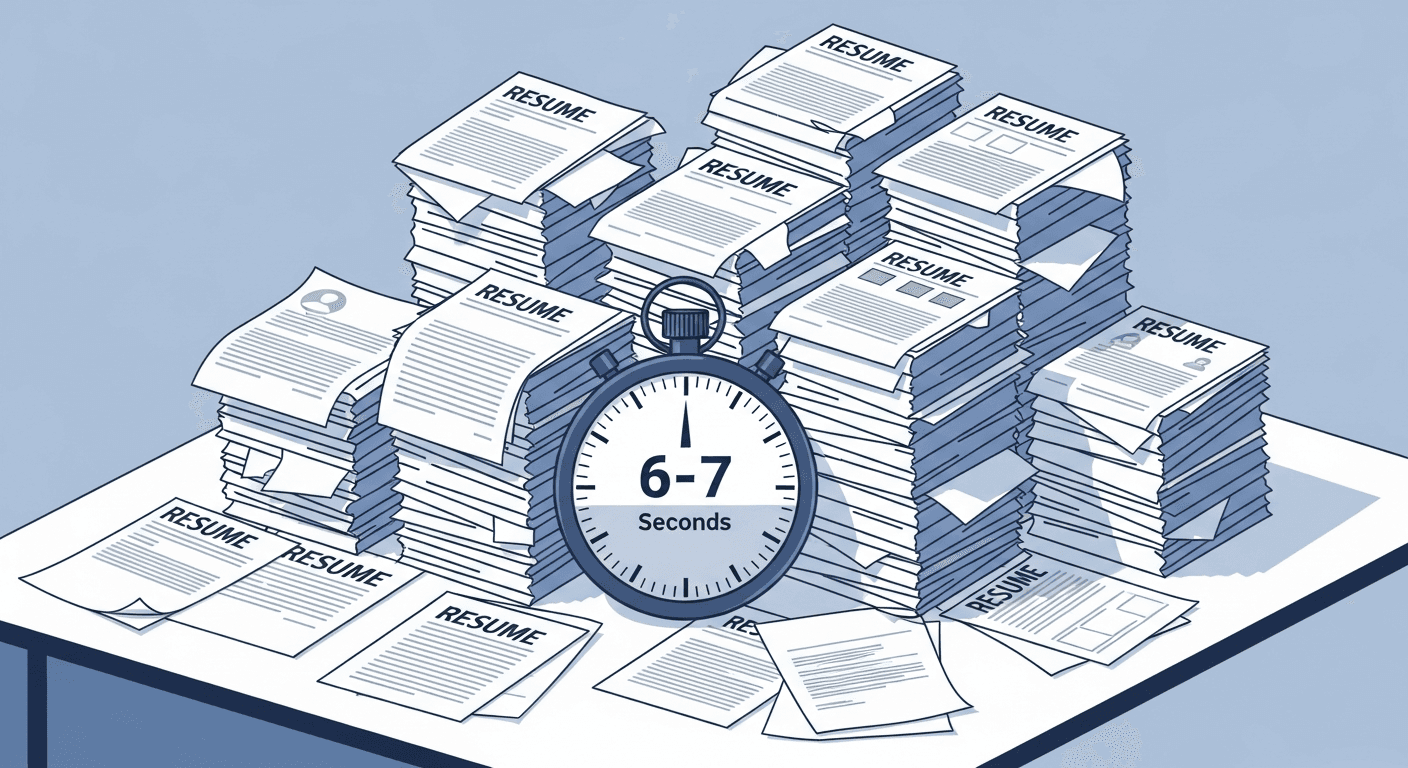
The numbers alone explain a lot. The average corporate job posting receives around 250 applications. Entry-level roles regularly hit 400 or more. Even if your resume is strong and your experience fits, recruiters are physically sorting through a crowd that size.
What that means in practice: hiring managers spend an average of 6-7 seconds on an initial resume scan. You're not being judged carefully. You're being filtered quickly.
Getting no interview calls doesn't mean you're unqualified. Sometimes it means you're one of 400 people who were all reasonably qualified, and the math simply wasn't on your side.
Your Resume Doesn't Showcase Measurable Results
Most resumes read like job descriptions. Yours probably does too.
"Responsible for managing social media accounts" tells a recruiter nothing they couldn't guess. "Grew Instagram following by 40% in three months" tells them you can actually do the job. That shift, from duties to outcomes, is what separates forgettable resumes from ones that get calls.
Swap vague responsibility statements for results wherever you can:
"Managed a team" → "Led a team of 6 to deliver a project two weeks ahead of schedule"
"Handled customer complaints" → "Resolved 95% of support tickets within 24 hours"
"Assisted with sales" → "Contributed to $200K in new revenue in Q3"
If you don't have hard numbers, use percentages, timeframes, or scale. Even approximate impact beats a blank.
You're Not Applying Early Enough
Timing matters more than most people realize, and it's one of the easiest fixes on this list.
Recruiters don't wait until a posting closes to start reviewing. Many stop reading new applications once they have a solid pool of candidates, which often happens within the first few days. Research from LinkedIn found that applying within the first 10 minutes of a posting going live makes you 4x more likely to get an interview.
If you're applying a week after something goes live, you're often already too late. Not because you're unqualified, but because the recruiter already has a shortlist.
Set up job alerts and treat new postings like they have an expiration date. Apply the same day, ideally within 24 to 48 hours.
Your Professional Online Presence Isn't Supporting Your Application
Recruiters don't stop at your resume. Most will search your name online before deciding whether to move forward, and what they find can quietly disqualify you.
LinkedIn is the first stop. If your profile is sparse, has a different job title than your resume, or hasn't been touched in years, that inconsistency raises questions. A recruiter who can't verify your experience isn't going to reach out for clarification. They'll just move to the next candidate.
A few things worth checking right now:
Your LinkedIn headline and job titles should match your resume exactly, since any discrepancy signals carelessness or dishonesty. You can also create a tailored resume from LinkedIn to keep everything consistent.
Your profile photo should be professional and recent, because a missing or unprofessional photo can reduce profile views noticeably.
Your work history dates need to align with what you submitted, as recruiters actively cross-reference these details.
Having at least a few recommendations or endorsements visible adds credibility that a resume alone cannot provide.
Your online presence just needs to confirm what your resume already says, not contradict it.
You're Relying Only on Online Applications Instead of Networking
Sourced candidates, meaning people referred or found through connections, are 8x more likely to get hired than someone who applied cold through a job board. However, AI job application tools can help cold applications get noticed too. If the average board hire rate sits around 0.5%, referrals push that closer to 4%. That's a real gap.
The fix doesn't require becoming a networking superfan. Tell people in your field you're looking, comment genuinely on LinkedIn posts, and ask former colleagues if they know of openings. One warm introduction can do what 50 cold applications couldn't.
You're Wasting Time on Ghost Jobs
Not every job posting is a real opportunity. Between 18% and 30% of online job listings in 2025 were ghost jobs, roles companies posted with no immediate plan to fill. Some are collecting resumes speculatively. Others forgot to take the listing down after hiring internally.
A few signs you might be looking at a ghost job:
The posting has been live for 60+ days with no updates
The job description is vague with no clear team, scope, or reporting structure. When you do find legitimate openings, use ATS-friendly resume builders to format your application correctly.
The company has posted the same role repeatedly over several months
There's no named contact, recruiter, or department listed anywhere
If a listing checks multiple boxes above, skip it and spend that energy elsewhere. Time spent applying to dead postings is time not spent on roles that are actually open.
Application Strategy | Response Rate | Time Per App | ATS Optimized | Scalability |
|---|---|---|---|---|
Generic Manual Resume | 2-3% | 5-10 min | Rarely | High volume, low quality |
Tailored Manual Resume | 10-15% | 30-60 min | If done correctly | Low volume, high quality |
Sprout (AI-Powered) | 10-15% | Under 1 min | Yes, auto-matched keywords | High volume, high quality |
Networking / Referrals | ~4% hire rate | Varies | Often bypasses ATS | Limited by connections |
How AI-Powered Tools Can Increase Your Interview Rate
Every problem covered in this article has the same root cause: too much manual work, too little personalization, and not enough time. Sprout tackles all of it at once.
When you apply through Sprout, the AI pulls keywords directly from each job description and rewrites your resume bullets to mirror that exact language. Your skills get reordered based on what that specific role needs. The result is an ATS-optimized, tailored resume for every single application, without you spending an hour on each one.
The swipe-to-apply feature means you can move fast without going generic. Learn more about technology that helps you auto apply to jobs while keeping applications tailored. Each application still gets a custom cover letter and role-specific resume tailored to that exact job description. You get the speed advantage without sacrificing the personalization that actually gets interviews.
The built-in dashboard tracks every application so you always know what's been submitted, what's pending, and what needs follow-up. Compare this with other job application tracker tools on the market. Nothing gets lost. In October alone, Sprout users landed 2,738 interviews at companies like JPMorgan, Nike, and Wells Fargo. This proves that tailored, ATS-optimized applications generate real callbacks.
If you're putting in the effort but not seeing results, the problem probably isn't you. It's the process.
FAQs
Can I apply to 100+ jobs without spending hours on each application?
Yes. AI-powered tools like Sprout automatically generate ATS-optimized, tailored resumes and cover letters for every job you swipe on, pulling keywords directly from each job description and rewriting your bullets to match, so you get both speed and personalization without manual work.
What steps can you take if you are not getting interviews after applying online?
Apply within 24-48 hours of a posting going live (you're 4x more likely to get an interview), verify your LinkedIn matches your resume exactly, and avoid ghost jobs that have been posted for 60+ days with vague descriptions. Time spent on dead listings is time wasted.
Why is my resume not getting shortlisted even though I have experience?
Your resume probably lacks measurable results and uses generic responsibility statements instead of outcomes. Replace phrases like "managed social media" with specific achievements like "grew Instagram following by 40% in three months." Recruiters spend only 6-7 seconds scanning, so impact needs to be immediately visible.
Final Thoughts on Breaking Through the Application Black Hole
If you're still asking "why am I not getting interviews," the answer is almost always fixable: ATS formatting, generic resumes, slow timing, or ghost jobs. Tighten up those areas, speed up your application timing, and let Sprout handle the tailoring and optimization for you so you can start landing interviews faster.