


Summary
Compare Sprout vs JobCopilot job application tools in May 2026. Learn which tool delivers better interview rates through tailored resumes and ATS optimization.
This Sprout vs. JobCopilot comparison breaks down how each tool handles resume tailoring, ATS formatting, and application tracking. The core difference: one lets you review roles before applying, the other runs in the background without visibility. If knowing which resume version went where matters to you, that distinction shapes everything.
TLDR:
JobCopilot focuses on high-volume automation starting around $19/month.
Tailored applications that align closely with job-specific keywords may perform better in applicant tracking systems and recruiter reviews.
Sprout pulls keywords from each job posting to rewrite resume bullets and generate custom cover letters per role.
20 well-targeted applications typically yield more interviews than 100 generic ones sent without review.
User control over which roles receive your application matters as much as how many applications go out.
What Are AI Job Application Tools and How Do They Work?
AI job application tools automate the parts of a job search that eat up the most time. At their core, most AI job application tools do a few things: scan job boards and company career pages for open roles, auto-fill application forms using your saved profile data, and submit applications on your behalf.
The more capable ones go further. They pull keywords directly from individual job descriptions to tailor your resume for each role, generate custom cover letters, and log every submission in a dashboard so nothing slips through the cracks.
Where tools differ is in how much is truly automated versus how much gets handed back to you. Some run entirely in the background with zero visibility into what went out or where. Others put you in control, letting you review roles before applying. That distinction shapes the quality of what actually reaches employers, and frankly, it matters more than raw application volume.
Sprout vs. JobCopilot: Core Features Compared
Side by side, these two tools share a common premise but diverge quickly on execution.
Feature | Sprout | JobCopilot |
|---|---|---|
Auto-apply | Swipe-to-apply | Background automation |
Resume tailoring | Per-job, keyword-matched to each listing | Template-based, largely static |
Cover letter generation | Custom per application | Limited customization |
Job discovery | Verified career pages and trusted boards | Job board aggregation |
Application tracking | Full dashboard with status, follow-ups, and offers | Basic tracking dashboard |
Mobile app | iOS and Android | Web only |
ATS optimization | Standard headers, clean formatting, no broken parsing | Not a stated focus |
User control | Choose to review or automatically send the applications. | Minimal |
Where JobCopilot handles the submission side at volume, it largely sends the same documents across roles. Sprout is designed to tailor resume and generate customized cover letters for each job, pulling keywords directly from that specific listing.
Pricing and Plans: Which Tool Offers Better Value
Pricing is often where job seekers make or break their tool choice, so it's worth looking at both options carefully.
JobCopilot's paid plans start around $28/month, with higher tiers unlocking more automated applications per day. The appeal is clear: pay a flat rate and let the bot run. But because those applications are largely untailored, the volume you're paying for may not translate into proportional results.
Sprout's plans start at $20/month. You choose the roles you want to target, each application gets a resume and cover letter tailored to that specific job posting, and you skip listings that aren't a match, which tends to produce a stronger interview rate.
Which Pricing Model Actually Pays Off?
For job seekers who care about interview rates over raw application counts, a model that ties cost to quality outputs tends to go further. Research on hiring metrics suggests that high application volume doesn't always translate to better outcomes. Sending 100 generic applications often yields fewer callbacks than 20 well-targeted ones, so the math on "more applications per dollar" deserves some scrutiny before you commit.
Application Quality: Personalization vs. Volume
Automation and volume are only half the picture. In competitive hiring markets, quality over quantity in applications tends to win. 50 generic submissions rarely outperform 10 well-targeted ones.

JobCopilot leans heavily into volume. Its auto-apply feature submits applications across job boards at scale, but that speed comes with a tradeoff: the resume and cover letter sent to a software engineering role at a startup often looks nearly identical to the one sent to a senior analyst position at a Fortune 500 company. When personalization is thin, hiring managers notice.
Sprout takes a different approach. Each application is tailored by pulling the specific keywords, requirements, and language directly from the job posting. The resume gets restructured with ATS-friendly formatting, using standard section headers and clean layouts that parsers can read without issues. Cover letters are written to reflect the actual company and role, not a generic template swapped with a company name.
Why Tailoring Matters for Interview Rates
Available reports suggest that applications aligned closely to job description language may be easier for applicant tracking systems and recruiters to review as relevant. A field experiment by ResumeGo across 7,287 real applications found that tailored cover letters and callback rates are closely linked. Job-specific cover letters produced over 50% more callbacks than generic ones. Sprout's tailoring process ties resume content directly to job-specific keywords, which helps with parsing and relevance scoring instead of just submission count.
The question worth asking: do you want more applications sent, or more interviews booked?
ATS Compatibility and Resume Optimization
Getting through an ATS comes down to how well your resume is structured. 70% of large companies use applicant tracking systems to screen candidates, and design choices like tables, text boxes, and complex multi-column layouts can sometimes create parsing issues in certain ATS platforms, regardless of how relevant your content is.

ATS optimization is less accentuated in JobCopilot's public positioning, which leaves formatting decisions largely in the hands of the template you happen to choose.
Sprout takes a more deliberate approach here. Resumes generated through Sprout use standard headers, clean single-column layouts, and straightforward formatting that improves the chances your application is properly parsed. On top of that, Sprout tailors each resume to the job posting by pulling out job-specific keywords and weaving them into your resume in context, instead of simply appending a keyword list at the bottom. That kind of targeted alignment helps your application rank better within ATS scoring, which improves the likelihood it reaches an actual recruiter.
What Good ATS Optimization Actually Looks Like
There are a few things worth checking for in any AI job application tool:
Resume formatting that avoids tables, graphics, and multi-column sections that can confuse parsers
Keyword integration tied directly to the job description, not generic industry terms
Section headers that match what ATS systems expect, like "Work Experience" and "Education"
Output that produces clean, parseable files instead of design-heavy templates
User Control and Application Transparency
Running applications in the background sounds convenient until you have no idea what went where. If a tool submits dozens of applications without your input, you can't verify which resume version was used or whether those roles were even relevant to what you're targeting.
JobCopilot largely operates this way, with minimal visibility once automation kicks in.
Sprout takes a different approach. You review and choose each role before anything gets submitted. The web app keeps a clear record of which resume went to which company, and you can set preferences to filter out irrelevant roles or exclude specific employers entirely. If something feels off, you can pause or stop applications at any point.
For most job seekers, that kind of transparency only becomes a priority after they've lost track of where they applied, what version of their resume went out, or why they're getting calls from companies they don't remember targeting.
Interview Results and Success Metrics
Available reports suggest that interview rates are one of the most telling ways to judge any AI job application tool, and the two products tell pretty different stories here.
JobCopilot leans heavily on volume. The idea is that more applications mean more chances, which can be true in theory. But when applications go out without meaningful tailoring, many of them blend together in a recruiter's inbox or get ranked lower by ATS filters that reward keyword alignment with the specific job description.
Sprout takes a different approach. Each application gets a resume tailored to the actual job posting, with keywords pulled directly from that listing and mapped to your experience. Cover letters follow the same logic, referencing the specific role and company instead of using a generic template. The goal is fewer applications that land better, not more applications that get ignored.
How Sprout Balances Speed with Interview Conversion
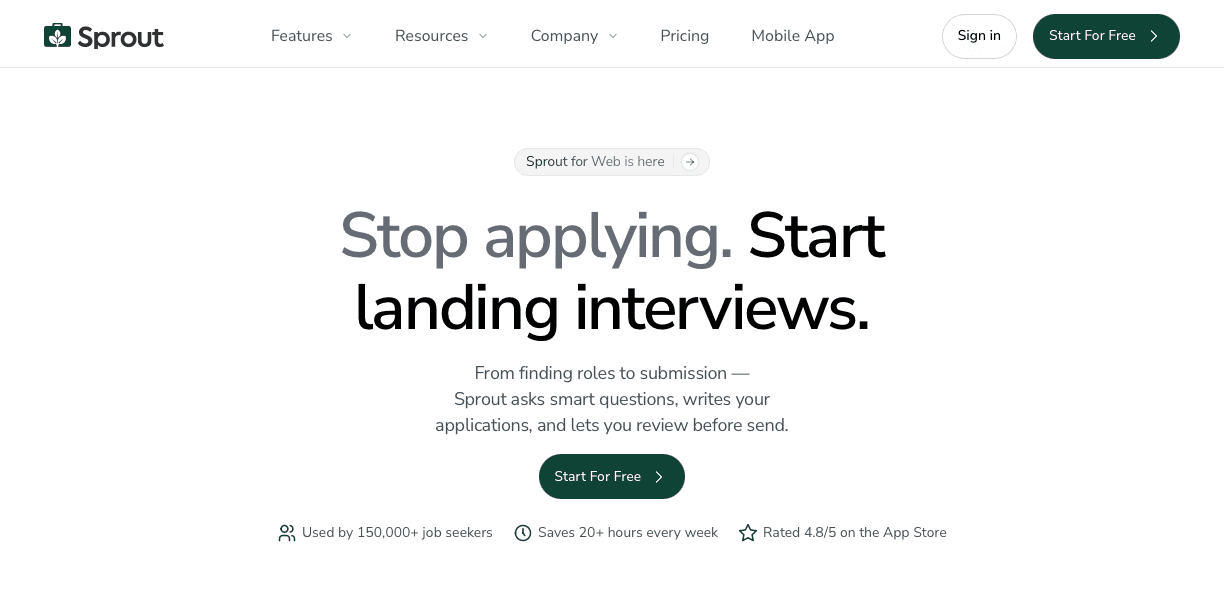
Sprout is built around a straightforward idea: applying fast only matters if those applications actually lead to interviews. Volume without personalization tends to produce a lot of silence from recruiters.
Every application Sprout generates includes a tailored resume and cover letter tied to the specific job posting. The resume is formatted for ATS compatibility, using standard headers and clean structure so it has a better chance of being parsed correctly before a human ever sees it. Keyword alignment is pulled directly from each job description, so the content reflects what that specific employer is scanning for.
The result is fewer spray-and-pray applications and more targeted ones. Available data suggests that personalized applications can meaningfully improve response rates, and Sprout's approach is designed with that outcome in mind. If you want a faster job search without sacrificing the quality of each submission, Sprout is a strong place to start.
FAQs
Can I control which jobs get my application with either tool?
With Sprout, you review and swipe on each role before anything gets submitted, and you can set preferences to filter out specific companies or irrelevant positions. JobCopilot runs mostly in the background with minimal visibility, so you have less control over where your applications actually go.
What's the best AI job application tool if ATS compatibility matters?
Sprout is built with ATS compatibility as a priority, using standard section headers, clean single-column formatting, and job-specific keyword alignment pulled directly from each listing. JobCopilot doesn't treat ATS formatting as a stated focus, which can hurt your chances of being properly parsed before a recruiter sees your resume.
How does pricing work for Sprout compared to JobCopilot?
JobCopilot charges a flat monthly rate (starting around $19/month) for a set number of automated applications per day. Sprout uses a credit-based model where each credit funds a fully tailored resume and cover letter for a specific job, so you're paying for quality outputs instead of raw application volume.
Final Thoughts on Making Your AI Tool Choice Count
Choosing between tools like Sprout vs. JobCopilot depends on what outcome you're measuring. Sending more applications feels productive but it doesn't always move the needle if those resumes look identical to every other candidate's. ATS parsers rank applications based on how well your resume aligns with job-specific keywords, so personalization tends to outperform volume when interview rates are involved. Sprout is built around that idea, tailoring each resume and cover letter to the specific job posting so your applications rank better and reach more recruiters. If getting callbacks is the goal, it's a strong place to start.